The short answer
Build the noon, afternoon, and night windows in advance, verify local affiliates, assign priorities, and let the active slate change as games enter commercials, halftime, and final.
Build each kickoff window
Plan the noon, afternoon, and evening groups before the day begins.
Verify local affiliates
Confirm which local ABC, CBS, NBC, Fox, or Telemundo affiliate carries each game and override a mapping when needed.
Set rivalry and team priorities
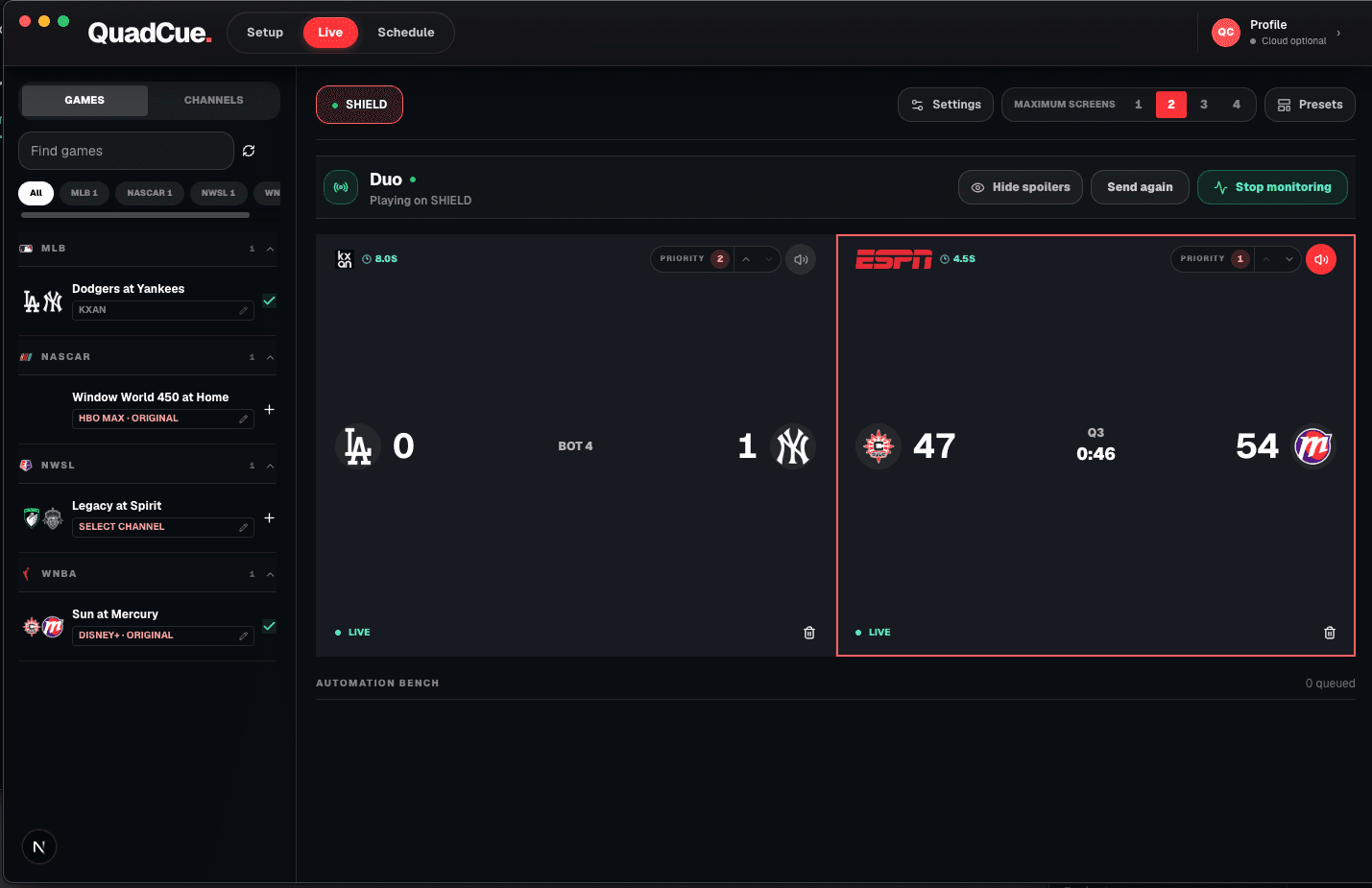
The priority stack tells Core which game deserves attention when several are live.
Transition between windows
Remove finals and admit the next scheduled games without leaving the automation bench stuck.
Optional receiver hardware
Use the screen you own. Add a receiver only if you need one.
QuadCue works with TV-class sessions, so there is no reason to replace compatible hardware. These links are shortcuts for adding a supported receiver to another screen.
As an Amazon Associate I earn from qualifying purchases.
Roku Express 4K+
A compact option for adding a TV-class Roku session to an existing screen.
View on Amazon 02Low-profile 4K stickRoku Streaming Stick 4K
A portable Roku receiver for screens where a box would add unnecessary clutter.
View on Amazon 03Fire TV receiverFire TV Stick 4K
A 4K Fire TV option that runs the television version of supported streaming apps.
View on AmazonAmazon controls product details, availability, and checkout. QuadCue does not show copied prices or ratings.
Organize a twelve-hour Saturday
Separate noon, afternoon, prime-time, and late-night kickoffs into manageable groups. College football games vary widely in duration, so keep enough capacity for an earlier event to run into the next window.
Verify the local station attached to every broadcast-network listing. Affiliate names differ by market, and an automatic match should remain editable when the lineup or provider data points to the wrong local channel.
Rank rivalry games and favorite teams before using score-based urgency. A neutral close finish may deserve temporary audio, but it should not permanently displace the game the room gathered to watch.
Plan the final transition as carefully as the opening slate. Removing completed games, admitting late kickoffs, and reducing unused screens keeps the room coherent through the night instead of leaving an abandoned noon layout on the wall.
Frequently asked questions
Does QuadCue remove ads from the stream?
No. QuadCue changes audio focus and game placement; it does not alter the provider video stream.
Does QuadCue work on phones or tablets?
No. Current YouTube TV control is designed for TV-class apps and consoles.