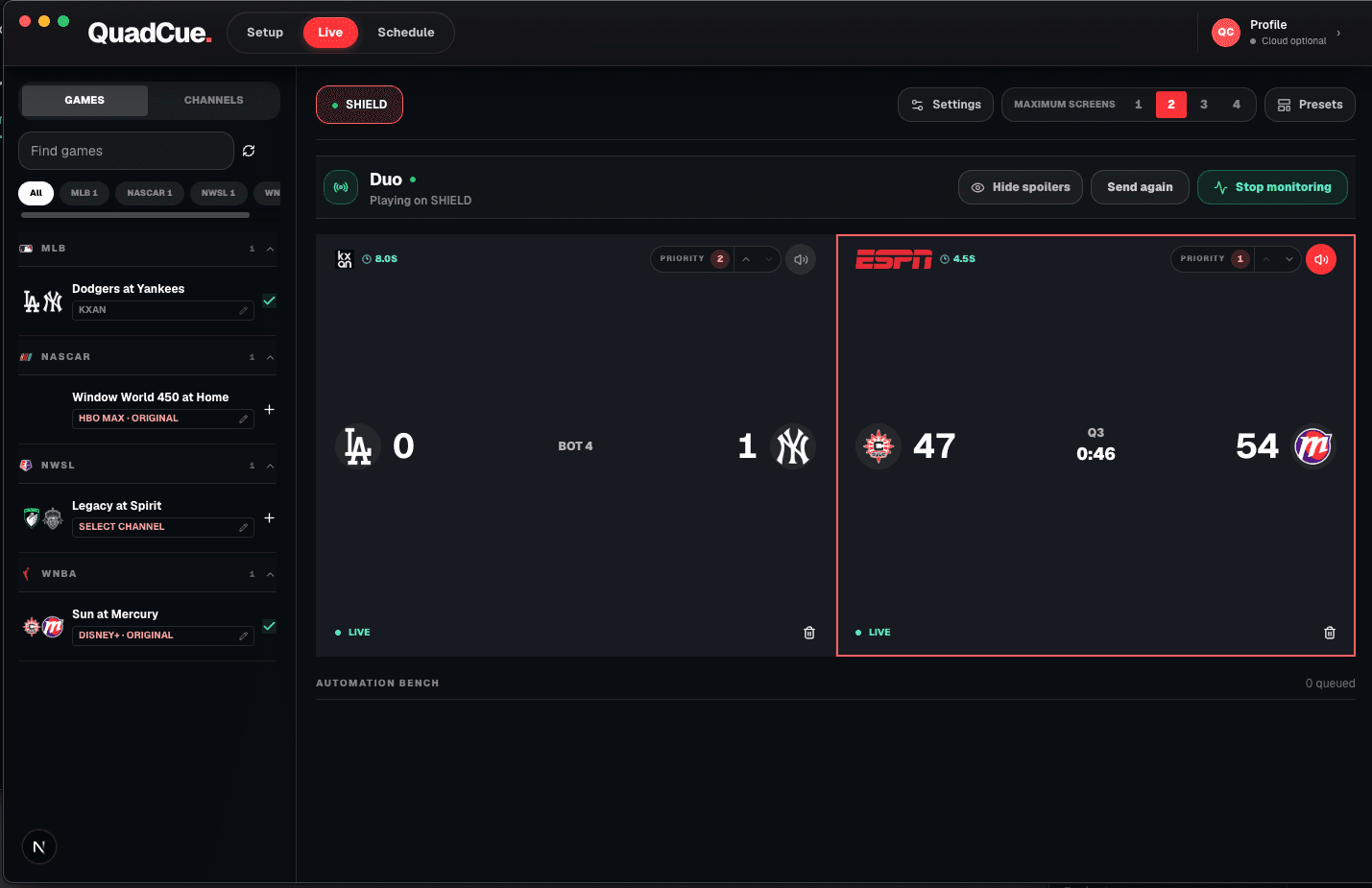
The short answer
Use YouTube TV multiview for up to four simultaneous games on one compatible TV device. Add separate TV-class screens only when a game needs to stay full-size or the slate exceeds one multiview, then organize early, late, and prime-time windows before kickoff.
Choose one multiview or several TVs
One screen is the simplest answer for most rooms. YouTube TV can show up to four eligible live channels in one multiview, with one tile supplying the active audio. Multiple TVs become useful when a matchup needs a full-size picture, the room has different viewing areas, or more games overlap than one multiview can hold.
- One TV: up to four eligible games in a multiview
- Two TVs: one full-size priority game plus a multiview
- Several TVs: separate full-size games with a single primary audio source
Build the NFL multiview
On a compatible smart TV or streaming device, start an eligible live game, press down, choose Multiview, and add available games in the builder. NFL Sunday Ticket and local NFL feeds can be combined when the account includes the required access. Web browsers do not support multiview.
Set the home network before Sunday
YouTube says NFL Sunday Ticket programming has unlimited in-home streams when the current network is set as the home network. Outside the home, NFL Sunday Ticket allows two separate streams. Confirm the home-network setting and account login before kickoff rather than discovering a limit during the early window.
Add receiver hardware only where it solves a problem
Keep a built-in smart-TV app when it is current and reliable. Add a Roku or Fire TV receiver when an older screen lacks a supported TV-class app, its built-in software is unstable, or standardizing the room would make Sunday operation easier. The buying shortcuts below use QuadCue’s dedicated Amazon tracking ID.
Program the early, late, and prime-time windows
Create separate groups for the early and late Sunday windows, rank the games before kickoff, and remove finals as the next group begins. Treat the prime-time game as a clean final stage instead of preserving an unnecessarily busy wall.
Keep one game audible
A wall of simultaneous commentary is worse than missing a screen. Pick one primary audio path, move it to the most important live game, and treat commercial breaks as state changes. QuadCue is designed to automate that repeated focus work around the provider multiview.
Optional receiver hardware
Use the screen you own. Add a receiver only if you need one.
QuadCue works with TV-class sessions, so there is no reason to replace compatible hardware. These links are shortcuts for adding a supported receiver to another screen.
As an Amazon Associate I earn from qualifying purchases.
Roku Express 4K+
A compact option for adding a TV-class Roku session to an existing screen.
View on Amazon 02Low-profile 4K stickRoku Streaming Stick 4K
A portable Roku receiver for screens where a box would add unnecessary clutter.
View on Amazon 03Fire TV receiverFire TV Stick 4K
A 4K Fire TV option that runs the television version of supported streaming apps.
View on AmazonAmazon controls product details, availability, and checkout. QuadCue does not show copied prices or ratings.
Build the Sunday run of show
Check the local broadcast map and subscription access early in the week. NFL Sunday Ticket covers eligible out-of-market Sunday afternoon games; local and national availability still depends on the account and location.
Update the YouTube TV app and test the receiver at the actual screen. Google notes that some older devices offer fewer multiview customization options or reduced picture quality.
Use score margin and game clock as context, not the only priority. A favorite team, fantasy implication, or elimination scenario may matter more to the people in the room.
Run a five-minute rehearsal: open a game, create the multiview, switch active audio, expand one tile, and return. That test catches login, network, and remote-control problems before guests arrive.
Frequently asked questions
Can YouTube TV show four NFL games at once?
Yes. Eligible live games can be combined into a multiview with up to four channels on supported devices.
Does NFL Sunday Ticket allow multiple TVs at home?
YouTube says NFL Sunday Ticket programming has unlimited in-home streams when the home network is configured. Separate YouTube TV base-plan content can have different limits.
Can I build an NFL multiview in a web browser?
No. YouTube TV says multiview is unavailable in web browsers. Use a supported TV, streaming device, or supported mobile experience.
Does QuadCue remove ads from the stream?
No. QuadCue changes audio focus and game placement; it does not alter the provider video stream.
Does QuadCue work on phones or tablets?
No. Current YouTube TV control is designed for TV-class apps and consoles.